
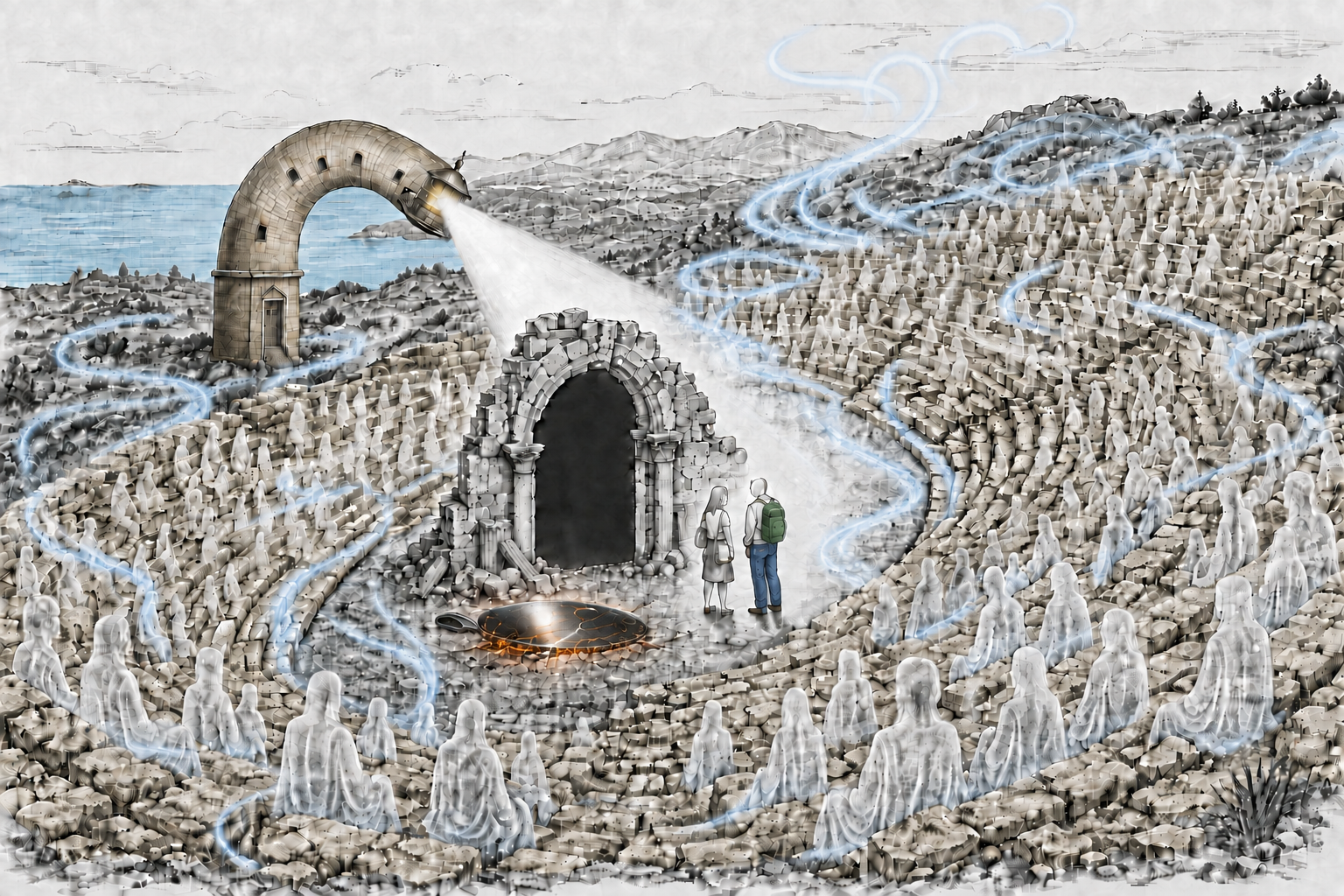
Nikos looked at the woman without answering..
“Tell me a lie,” she repeated. “Something simple. Something we both know isn’t true.”
The audience waited.. Their stillness had changed quality, no longer the stillness of obligation but the stillness of anticipation, the held breath of witnesses who have come to understand that what they are about to see matters.. The spectators seemed to lean forward slightly, though their bodies did not move, a collective attitude of attention that created a pressure against the air itself..
The lighthouse still towered above the horizon, far taller than it had any right to be.. Its beam travelled slowly across the stone rows, returning every few seconds to the obsidian with the regularity of a pulse, as though the stone and the light were engaged in a conversation that had begun before either of them arrived and would continue after they left..
Nikos looked towards the sky. The blue was deepening towards evening, though the afternoon still lingered in the lower air, a conflict of times that seemed appropriate to the conflict within himself. He searched for something to say, something false and harmless, a small dishonesty that would demonstrate the principle without exposing anything he wished to keep hidden.
“The sea is red,” he said..
The lighthouse shot upwards..
The movement was instantaneous, violent, a denial of the physical laws that should govern stone and metal.. Its beam struck the obsidian with such force that the stone flashed, a single pulse of white light that seemed to originate from within the blackness rather than reflecting from its surface.. White light flooded the air around them, and the spectators began stamping their feet against the ancient seats, the sound now rhythmic, almost orchestral in its coordination..
The woman stepped back. The light had acquired a texture, a pressure against her skin that felt almost solid..
“Stop it,” Nikos said.
“I’m not doing anything.”
The obsidian had begun to burn again. Its heat passed into the stones of the theatre and spread beneath their feet, no longer localised but general, as though the entire site were being heated from below by some subterranean source that responded to the words being spoken above it.
“Tell the truth,” she said.
“The sea is blue.”
The light softened at once. The lighthouse descended slightly, and the stamping ceased. The transition was so immediate, so obedient to the structure of his words, that the impossibility of the phenomenon became, paradoxically, harder to deny. A coincidence would have lagged, would have required interpretation. This required only acknowledgment.
The woman looked at Nikos.
“So that’s how it works.”
“It’s nothing,” he replied. “A coincidence.”
The lighthouse rose again..
A wave of disapproval swept through the seats. The obsidian grew searing hot, and Nikos stepped back, shielding his eyes from the blinding light. The heat was not the comfortable warmth of sun on stone but something more aggressive, a demand that he recognise what he was trying to dismiss.
The woman said nothing.. She did not need to..
He had already provided the proof he refused to accept..
“Don’t you believe what is happening?” she asked at last.
“I believe in what I can explain.”
The beam did not change.. It was the truth..
“And mythology? How do you explain that?”
Nikos glanced towards the spectators, as though afraid that the names of Cephalus and Procris might be whispered again. The fear was not of the names themselves but of what they implied, the suggestion that his private reading, his solitary engagement with ancient stories, had somehow become public, had escaped the boundaries of his own mind and entered a space where others could see it..
“I don’t need to believe that myths truly happened in order to believe that they reveal something true about people.”
The beam remained calm……
For the first time, several spectators relaxed in their seats.. The relaxation was visible in their shoulders, in the angle of their heads, a small physical change that communicated approval more clearly than any sound could have done.. They had heard something they recognised, an honesty that did not require them to believe in the impossible, only to acknowledge the possible..
“Then why can’t you believe that this might reveal something true about us?”
Nikos turned towards her.. “There is no us. I have only just met you.”
The obsidian flashed..
The audience erupted into louder disapproval. Someone shouted something that was lost beneath the other voices, a single syllable of protest that could not find its place in the collective noise. Nikos felt the heat penetrate the soles of his shoes, a discomfort that was not yet pain but was moving towards it with steady purpose.
“I didn’t lie!” he shouted..
The beam became so intense that, for a moment, the entire theatre lost its colour. Everything became white, not the white of light but the white of absence, as though the world had been stripped of its capacity to differentiate, to hold distinctions between stone and sky, between self and other..
The woman watched him but did not insist upon the word he had used. She did not yet know what us could possibly mean between two people who had only just met. The word had emerged from her without calculation, a natural form of reference that she had not examined before speaking it. Now, hearing it echoed back with such denial, she felt not embarrassment but curiosity. Why had she said it? What had she already begun to feel that her conscious mind had not yet acknowledged?
Perhaps the theatre did not respond solely to the things they knew.. Perhaps it also responded to what they had already felt but refused to recognise.
“Why did you really come here?” she asked.
“To see the theatre.”
The lighthouse rose higher still, and the light struck the obsidian, and its black surface opened like a mirror. The opening was not physical, the stone did not crack or change shape. It simply became transparent to something else, a window into a depth that had not been visible before..
The theatre was no longer reflected inside it..
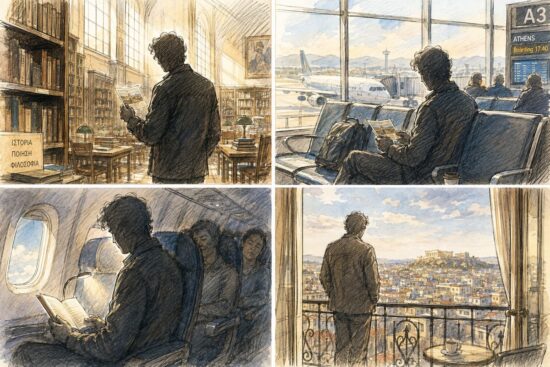
Instead, it showed Nikos standing alone in a municipal library, holding the postcard. The image was not flat like a photograph but dimensional, a moment preserved in its fullness, with the particular quality of afternoon light that enters libraries through high windows, with the smell of old paper, with the silence that is not empty but full of the presence of absent readers. Then the image shifted. He was sitting at the airport gate, reading the message, his body tense with the particular anxiety of waiting for departure, the suspended state in which one has left but not yet arrived.. Next, he appeared aboard the plane, the book open in his hands, the cabin dark around him, other passengers sleeping, his face illuminated only by the small reading light. Finally, he stood on the balcony of his hotel room, looking out across Athens as though searching the city for a reason not to follow the thing that had brought him there..
Nikos moved closer to the obsidian..
“Those are memories.”
“Your memories,” the woman said. “So you know the answer.”
The spectators leaned forwards. The movement was synchronised, a physical expression of interest that seemed to come from a single will distributed among many bodies.
“Why did you come?” she repeated.
Nikos looked at the postcard still held in his hand. It had become slightly damp from his palm, the edges softening in a way that made it feel more like skin than paper.
“Because I wanted to know who wrote it.”
The light retreated slightly, but it did not soften completely..
A partial truth.
The audience murmured with displeasure.. The murmur was not loud but it was persistent, a continuous note of dissatisfaction that seemed to come from everywhere at once..
“And why did that matter so much to you?”
“I don’t know.”
The lighthouse remained still.
His uncertainty was genuine, but it was not the whole truth. The woman could see this, could see the way his eyes moved slightly when he spoke, the small tension around his mouth that betrayed the existence of something he was not yet willing to name.
The woman looked at the message on the back of the postcard.
“Did you feel it had been written for you?”
Nikos did not answer.
The obsidian began to burn more fiercely, although he had not spoken a lie. His silence had taken its place. The theatre, she was beginning to understand, did not distinguish between the falsehood of words and the falsehood of withholding. Both were forms of hiding.
A voice rose from the stone seats: “Silence can lie too.”
Nikos closed his eyes. The voice seemed to come from inside his own head as much as from the theatre around him, a sentence that named something he had always known without having been able to articulate it.
“Yes,” he said at last. “I felt that someone was calling me personally.”
The lighthouse descended. The air became breathable again, losing the charged quality that had made each inhalation feel like drinking something too strong.
“Who?”
“I don’t know.”
“Then why did you obey?”
Nikos gave a nervous laugh. The laugh was a defence, a small attempt to reframe the conversation in terms that would allow him to keep his distance from it.
“I didn’t obey. I made a decision.”
The audience’s disapproval was immediate. The lighthouse surged upwards, its beam widening, the heat returning with a suddenness that made him gasp.
The light became white and merciless. The lighthouse grew until its summit disappeared into the glare. Nikos raised his hands to shield his face.
The woman stepped closer. She did not touch him. She stood near enough that he could sense her presence, a gentle pressure against the isolation that the light was trying to enforce.
“Why did you need a sign to give you permission to want something?”
“I didn’t need a sign.”
The obsidian shone, and a new image appeared across its black surface..
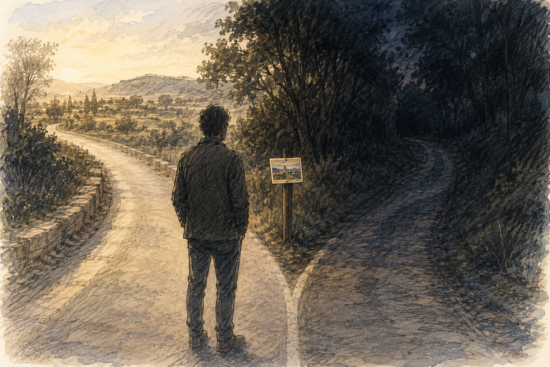
Nikos stood before a road that divided in two. One path was clear, safe, and familiar, its surface smooth, its destination visible. The other vanished into darkness. At its entrance stood the postcard, like a small sign granting him permission to continue. The image was not theatrical but quiet, almost domestic, the kind of scene that belongs to ordinary life rather than myth. But its very ordinariness made it more devastating.
“Stop,” he said.
No one moved.
“I don’t want to see this.”
The spectators remained bent towards him. Their attention was not cruel, it was simply absolute, the attention of witnesses who have understood that what they are watching is not performance but confession..
The woman realised that she was not the one choosing the questions. The place was setting them inside her and waiting for her to speak them aloud.. The words emerged not from her intellect but from some deeper source, a knowledge that the theatre had activated within her without her conscious participation..
“Why do you ask questions when you are afraid of the answers?”
Nikos turned sharply towards her.. “You know nothing about me.”
“That’s true.”
The lighthouse did not react.
Her admission unsettled him more than an accusation would have. He had prepared defences against accusation, had rehearsed responses to blame and criticism. But agreement, simple acknowledgment of limitation, left him with nothing to push against..
“But you ask a great many questions,” she continued. “Even a few moments ago, when you became frightened, you began asking them. What is happening? Who are these people? What is the lighthouse? Do you ask because you want to understand, or because you need to remain in control?”
“To understand.” .. The lighthouse rose.
“And to remain in control,” he added quickly. .. The tower lowered slightly..
The heat receded, but the spectators continued waiting. Their patience seemed infinite, the patience of stone that has learned to outlast human urgency..
“Do you do the same with people?”
Nikos remained silent.
“Do you ask questions because you want to know them, or because you want to discover, in time, why you should not trust them?”
The obsidian changed again.
Across its surface, Nikos appeared seated opposite a faceless woman. He asked her one question after another. With every answer she gave, another stone rose between them. Before long, a wall had formed so high that neither could see the other. The wall was not built by either of them alone, it was the product of his questioning, her answering, and the slow accumulation of distance that each exchange created.
Nikos turned his face away..
“Both,” he admitted.
The beam softened.
“If I discover something I don’t like soon enough, I can leave before…”
He stopped..
The spectators stamped their feet. The sound was not angry, it was urgent, a reminder that incomplete truths carry their own violence, that stopping before the end is itself a form of hiding.
“Before what?” the woman asked.
“Before it becomes difficult.”
The lighthouse rose.
“Before I become attached..” he said.
The tower descended..
The woman studied him for a moment in silence. She saw in him something she recognised, a strategy of self-protection that she had never examined in herself but that she understood instinctively, the way one understand a language one has heard without learning..
“Did someone make you feel that you were not enough?”
The question fell between them with more weight than any that had come before it. It was not an accusation, it was an inquiry, gentle but direct, the kind of question that can only be asked when the person asking has already admitted their own ignorance..
Nikos did not answer..
The obsidian began to pulse.. A small point of light appeared within its black surface and gradually assumed the shape of a bird with a broken wing.. The bird was small, ordinary, nothing mythical about it. Its vulnerability was what made it unbearable to watch..
Nikos knelt beside it. He lifted it carefully, cradled it in his arms, and protected it until its wing had healed. The image showed the passage of time, days of care, the gradual return of strength, the patience that is indistinguishable from love..
Then the bird flew away.
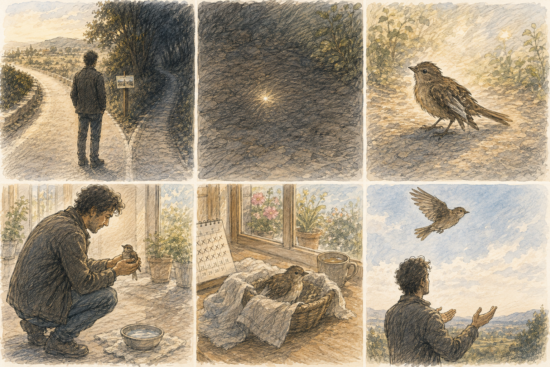
And he remained alone, his hands open and empty.
“Do you want to be loved,” the woman asked as she watched the image, “or do you want to be needed?”
“What is the difference?”
The lighthouse surged upwards so suddenly that the stones beneath their feet became scorching hot..
The audience roared its disapproval. The roar was not a sound but a pressure, a physical force that seemed to come from the stones themselves..
Nikos clenched his teeth against the pain..
“There is a difference!” he shouted.
The light softened slightly..
The woman approached the obsidian. The bird appeared again, except this time, once its wing had healed, it did not fly away. It remained upon Nikos’s open palm..
Free to leave.. Free to stay..
“If its wing had never been broken,” she asked, “if it did not need you to save it and could leave whenever it wished, would you believe it had chosen to stay with you?”
The theatre fell silent..
Even the lighthouse stopped moving..
Nikos stared at the bird perched upon the palm of his reflected self. There was no wound for him to heal, no danger from which he could protect it. He could not earn its presence by offering something it lacked. There was no transaction, no debt, no obligation.
He would simply have to believe that it remained because it wanted to.
“I don’t know,” he said.
The beam did not change.
“Are you afraid that you will love more than you are loved?”
“Yes.”
“Are you afraid someone will lie to you?”
Nikos looked at the woman.
Her face bore no resemblance to the images the obsidian had shown him. She did not know him. She had promised him nothing and had not asked him to believe her..
Yet, for some inexplicable reason, he trusted her..
That frightened him more than the theatre, the spectators, or the lighthouse towering above the horizon..
“I’m not afraid that someone will lie to me,” he said slowly. “I’m afraid that I will believe them.”
The tower began to descend.. The spectators remained motionless..
The woman waited.
Nikos knew he had not finished..
“And I’m afraid that if someone truly knows me, they won’t find enough reasons to stay.”
The beam lost its blinding whiteness.. The obsidian ceased to burn.. The bird opened its wings, flew once around the darkness of the stone, and returned to his palm..
Nikos took out the postcard and read once more the message that had brought him there: “If you ever find this, come before you decide that what frightened you was never meant for you.”
“That is why I came,” he said. “Because the message told me not to assume that the things which frighten me were never meant for me.”
He raised his eyes towards the woman.. “And I have spent years doing exactly that.”
The lighthouse descended until its summit disappeared beyond the horizon.. Its light, however, did not vanish completely.. A thin beam remained upon the obsidian.
Nikos took a deep breath. For the first time since arriving at the theatre, the stones beneath his feet were cool.
He thought it was over..
Then every spectator turned towards the woman at the same time.
A whisper rose from the stone seats: “Now Procris…..”
To Be Continued…
The theatre has heard Cephalus.
Now every stone is waiting for Procris.
And some answers are far more dangerous than lies..


Leave a Reply