
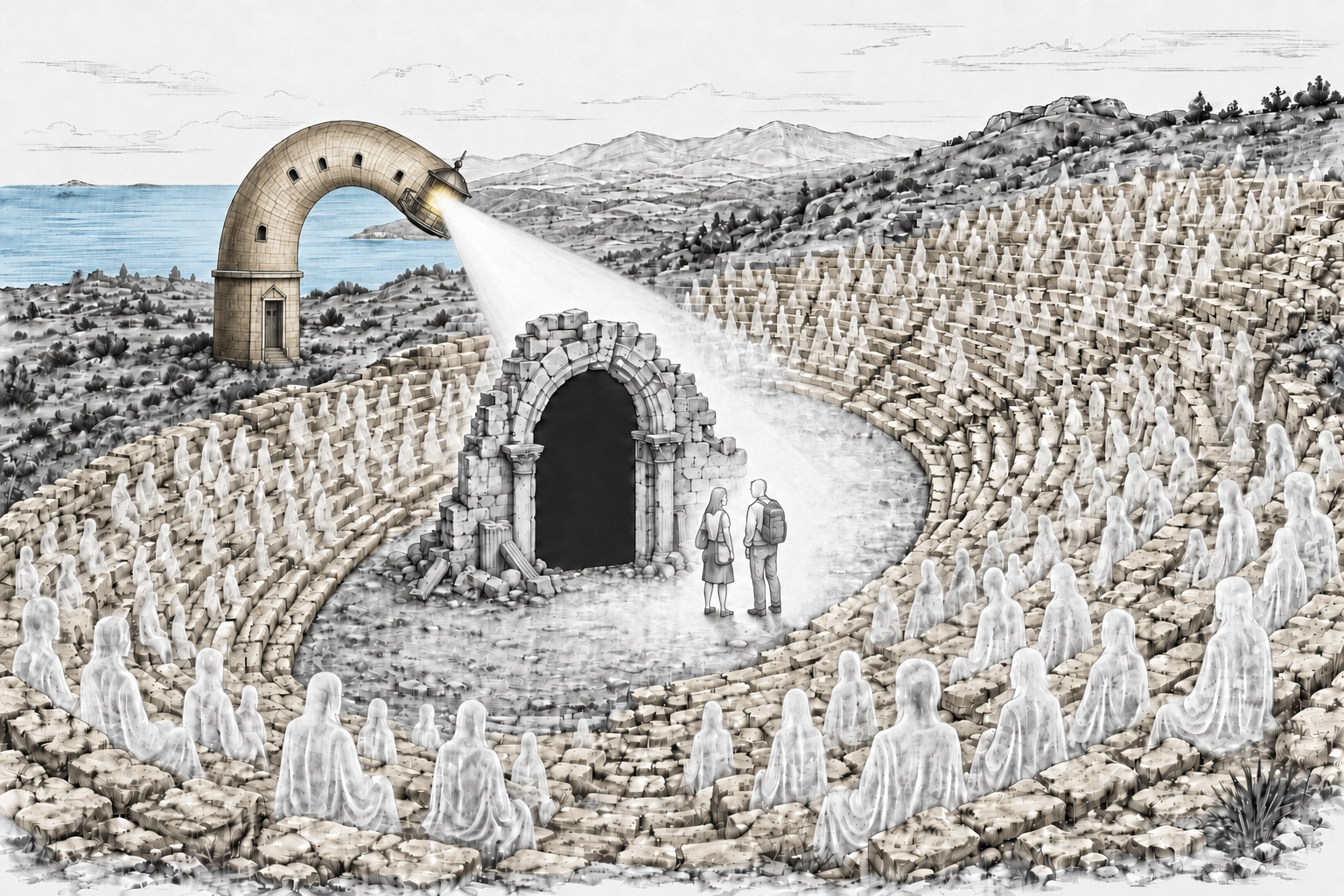
Neither of them moved..
The people who had appeared along the theatre’s stone rows remained perfectly still, their faces turned towards them. They did not speak to one another or shift in their seats. They showed no surprise at finding themselves there. They sat like spectators who had always known which performance they had come to witness, whose arrival was not an event but a fulfilment, the last piece of a pattern that had been assembling itself without their awareness. Their patience seemed geological, the patience of stone that has learned to wait through centuries because it has no alternative and has found, in the waiting, a form of presence that requires no movement to be real.
Only Nikos and the woman did not know..
The woman looked towards the entrance. Her blue car still stood alone beside the road, a small island of familiar colour in a landscape that had ceased to behave according to the laws she understood. No bus had arrived, no group of visitors had passed them. She had heard no voices, no car doors, no footsteps. The silence before their appearance had been complete, not the silence of emptiness but the silence of held breath, the kind that precedes a revelation rather than follows an absence..
The seats had filled within moments..
Nikos took a step towards her. The movement felt deliberate, almost formal, the way one approaches a stranger after an accident, uncertain whether to offer help or simply acknowledge that they have shared something they did not choose..
“Did you see them arrive?”
The woman shook her head.. The gesture was small, precise, and seemed to cost her something.. She did not add that she had been looking at the stone rows only seconds before, that she had glanced down at the obsidian on the ground and then up again, and in that interval, an interval she could not measure because her attention had been elsewhere, the change had happened.. It was less like seeing someone enter than like remembering they had always been there..
Somewhere among the stone seats, a person stamped one foot impatiently..
The sound was repeated on the opposite side of the theatre, and then from everywhere at once.. It was not yet applause or disapproval.. It sounded more like a warning addressed to the people standing upon the stage, delaying the beginning of the performance. The stamping was not synchronised, but arrived in waves, each source independent but contributing to a collective rhythm that seemed to have its own intelligence, its own sense of timing.. The woman tried to count the individual sounds and found she could not.. They merged into a single pressure, a demand made without words..
The obsidian still lay between them.. Its black surface reflected the lighthouse beam, spreading the light across the stones as though it were something alive, something that had been dormant and was now, through their presence, awakening to its function.. The stone no longer looked like a fragment but like an instrument, placed there for a purpose neither of them had been told..
The woman looked towards the sea..
The lighthouse was clearly visible now..
At first, she thought the distance and the strange light had distorted her perception.. The human eye, she knew, could be deceived by glare, by heat rising from stone, by the fatigue of a day spent in the sun.. Then she saw it growing.. The lighthouse rose slowly above the earth, as though an invisible hand were pulling it upwards. Its beam became stronger with every metre it gained, not in the abrupt way of a switched floodlight but in the gradual, inevitable way of something being revealed that had always been there, hidden by the limitations of ordinary sight..
“That’s impossible,” she whispered.
Nikos followed her gaze.. He had to turn his head fully, had to look past her shoulder, and the effort of this redirection made him aware of how fixed his attention had been on the spectators, on the woman, on the impossible fact of the obsidian.. The horizon had become a different kind of presence, one that required him to acknowledge a world beyond the immediate enclosure of the theatre..
“What is?”
“The lighthouse.”
“What about it?”
She did not answer immediately.. She knew the lighthouse at Vrysaki.. She had stood beside it and looked out towards the sea.. Its tower was only seven metres tall, and from where they were standing, it should not have been visible at all. She knew this with the certainty of repeated experience, the kind of knowledge that does not require confirmation because it has been tested so many times that it has become part of the ground upon which other knowledge rests..
Now it towered above the horizon..
Its beam swept across the theatre once more and struck the obsidian. The stone flashed. Heat spread beneath their feet so suddenly that they both stepped back, the sensation arriving not gradually but as a wall, a sudden occupation of their physical awareness that made the previous coolness of the stones seem like a memory from another place..
The spectators began stamping more forcefully..
The woman studied their faces. She could not distinguish their features clearly, only the displeasure beginning to distort them.. But it was not anger, she realised. It was something closer to disappointment, the expression of people who have been promised something and are watching the promise being broken in small increments, too small to protest individually but too consistent to ignore..
Then she remembered..
The obsidian had first grown warm when Nikos claimed that the postcard was not the reason he had come. It had burned inside her bag again when she said that she visited the theatre often..
Two answers.. Two lies..
The realisation did not arrive as a deduction but as a physical sensation, a settling in her chest that felt almost like relief, as though some part of her had known this all along and had been waiting for the rest to catch up. She understood, without knowing how she understood, that the stone was not merely an object. It was a register, a recording surface that responded to the vibration of falsehood with heat and light..
She lifted her eyes towards the lighthouse, which was still growing..
“It’s true,” she whispered.
Nikos turned towards her. The movement was slow, hesitant, as though he feared what he might see in her face.. “What do you mean?”
She took a deep breath. The air had changed quality, becoming denser, more charged, as though the atmosphere itself were preparing to receive something that had been withheld..
“I lied to you.”
The theatre fell abruptly silent. The stamping stopped with a precision that seemed mechanical, or perhaps supernatural, neither explanation comforted her. The silence was complete, absolute, the kind that makes the ears ring with the memory of sound..
Nikos stared at her without speaking.. His expression was neither accusatory nor surprised.. It was the expression of someone who has been asked to listen to something he has not prepared himself to hear..
“I haven’t been here a few times,” she continued. “I’ve never been here before. I live so close, but I had never visited the theatre. I was ashamed to tell you.”
For several moments, nothing happened.. Then the lighthouse beam began to soften..
The blinding white light lost its harshness and gradually regained the colour of late afternoon, that particular honeyed quality that belongs to the hour before sunset, when the sun has dropped low enough to pass through more atmosphere and emerges changed.. The tower slowly descended, as though sinking back into the earth. The obsidian continued to shine, but the heat beneath the stones began to subside, retreating like a tide that has reached its limit and must now return..
The woman approached carefully and touched its edge with her fingertips..
It was no longer burning..
But the lighthouse did not return to its true height..
It remained visible above the horizon, its beam still travelling across the theatre. The spectators did not disappear. They sat in their places and waited, their patience restored, their displeasure apparently cancelled by the small offering of truth she had made. But they did not leave. They did not disperse into whatever absence they had emerged from..
Something else was keeping them there..
The woman looked at Nikos. In the softened light, his face appeared younger, or perhaps more vulnerable, the distinction between the two was not clear to her.. She saw in him something she recognised: the reluctance to be fully seen, the habit of withholding that she understood because she shared it..
“I don’t understand what you’re telling me,” he said.
The light intensified.
It was a subtle change, but they both noticed it. The beam became whiter. The obsidian began to warm again beneath her fingertips, a gentle increase that reminded her of how a fever returns after a temporary abatement, how the body resumes its struggle after a deceptive pause..
A low, unified whisper rose from the stone seats.. It was not loud, but it carried with the peculiar clarity of whispered words in a silent space, each syllable distinct despite the distance.
“Cephalus is lying.”
A second voice, a woman’s this time, emerged from somewhere within the crowd: “And Procris knows.”
Nikos turned sharply towards the spectators..
He had heard both names clearly. Cephalus and Procris. The characters from the book he had borrowed from the municipal library, the two people whose love had been poisoned by suspicion, cruel tests, and lies. He had read their story in the aeroplane, had felt its relevance without being able to name it, had carried it with him as a lens through which to understand the journey he had undertaken without understanding its purpose..
But this was not happening.. It could not be happening..
Perhaps the jet lag, the heat, and the exhaustion had finally defeated him. Perhaps he was still in his hotel room, dreaming, and all of this, the woman, the spectators, the impossible lighthouse, was the architecture of a sleep that had become more vivid than waking. Perhaps he would wake soon beside the sealed window of his hotel, with the noise of Syntagma muffled beyond the glass, and laugh at the strangeness of his own mind..
The woman, however, searched for no such explanation..
She knew the story.. And she believed the whisper..
She withdrew her hand from the obsidian. The warmth remained in her fingertips, a ghost of sensation that seemed to have been absorbed rather than merely felt.. Nikos looked towards the lighthouse and then at the people who had filled the theatre.. His gaze moved between them as though searching for a connection, a logic that would allow him to understand what was being asked of him..
“What is happening here?”
“I don’t know.”
The beam remained unchanged.. This time, she had told the truth..
The woman looked down at the obsidian. She was beginning to understand, not what was happening, but the language through which the place was communicating with them. It was not a language of words, or not primarily. It was a language of correspondences, of actions and consequences arranged with a precision that suggested intention without revealing purpose..
A lie did not merely create more light but made the light unbearable..
And the truth did not extinguish it, it returned the light to its natural form..
The distinction felt important, almost sacred, a principle that governed not only this place but perhaps other places as well, places where the same laws operated unnoticed because the conditions for their visibility had not been met.. Most of life, she thought, might be governed by such laws, invisible until something reveals them..
She raised her eyes towards Nikos.
“Tell me a lie.”
He stared at her as though he were not certain he had heard correctly.. The request was so unexpected, so contrary to every social principle he had learned, that his mind seemed to stall, unable to process it into a category of appropriate response..
“What did you say?”
“A lie.. Any lie.. Tell me something that isn’t true!”
Nikos took a step back.
He did not know who this woman was. He did not know who the people watching them were, or how a seven-metre lighthouse had risen above the horizon to illuminate a black stone.. He did not know why the names of mythological figures were being whispered by voices he could not locate, or why the simple act of falsehood seemed to carry consequences beyond the moral framework he understood..
But he knew something she did not..
Her experiment was unnecessary..
He had already told a lie..
And the lighthouse remembered it..
To Be Continued…
Some truths are spoken while others wait for someone brave enough to ask the right question..
The lighthouse has listened to his confessions..
Now it turns toward hers..
What happens when the one asking the questions must finally answer them?


Leave a Reply