
“Is this your only piece of luggage?”
Nikos looked at the airport attendant as though he had not understood the question. She waited a moment, then repeated it with the same polite smile, the kind that belonged to a script she had recited many times before.
“Do you only have this one suitcase?”
It was as if he had been suddenly awakened from a thought that had carried him much farther away than a place filled with departures, announcements, and hurried travelers should have allowed. For a few seconds, he had been elsewhere entirely and not in the queue, nor in the terminal, but somewhere in the space between what he was leaving and what he was moving toward. The attendant’s voice pulled him back, and he found himself unexpectedly grateful for the mundane precision of her question. There was something clarifying about being asked to account for what he carried..
“Yes, just one. I’m taking this with me,” he replied, indicating the backpack hanging from one shoulder, its straps worn soft at the edges.
He checked in his suitcase and watched the conveyor belt carry it away, swallowed behind rubber flaps into the invisible machinery of departure. Then he passed through security, removing his shoes and belt with the practiced compliance of someone who had learned long ago that resistance at thresholds only delays the inevitable. He followed the signs to his departure gate, walking past bright windows where planes sat at angles that made them look paused mid-thought..
There, among people staring at their phones and others already asleep in the uncomfortable chairs, his hesitation returned. Not as a clear thought, but as that tightening inside the body that comes when you have travelled far enough to make turning back difficult, yet not so far that changing your mind is no longer possible. It lived somewhere beneath his ribs, a quiet contraction that felt almost like the body’s own way of keeping a secret from itself. He had left enough times to recognize the sensation.. He had never before followed it so far..
He glanced at the screen above the gate of the Australian carrier. The first flight of his long journey to Greece was still on time. The words seemed oddly fragile, as though they were promising something they could not guarantee. Yet there they were, glowing with administrative certainty.
He opened his backpack and took out an old book entitled Cephalus and Procris. Near the bottom of its spine was the stamp of a municipal library, the ink slightly faded, the letters arranged with the modest authority of public institutions..
Nikos had always been fascinated by mythology. He loved the way ancient myths could speak of human passions and fears that remained unchanged, no matter how many centuries had passed. They had a way of naming things that ordinary language avoided, the private jealousies, the tests disguised as devotion, the damage done by those who believed they were proving something. The myths did not judge, they simply showed. That was why he had borrowed this particular book two weeks earlier, without knowing then how strangely it would become connected to his own journey. It had been an idle choice, the way one reaches for something familiar without understanding that familiarity itself might be a form of preparation.
Its return date was still almost a month away. When he had taken it from the library, walking past the shelves with their particular smell of paper and civic patience, he had never imagined that he would bring it back after carrying it halfway across the world. The due date had seemed then like a distant border he would never approach. Now it felt like a promise he might not keep in the way he had intended..
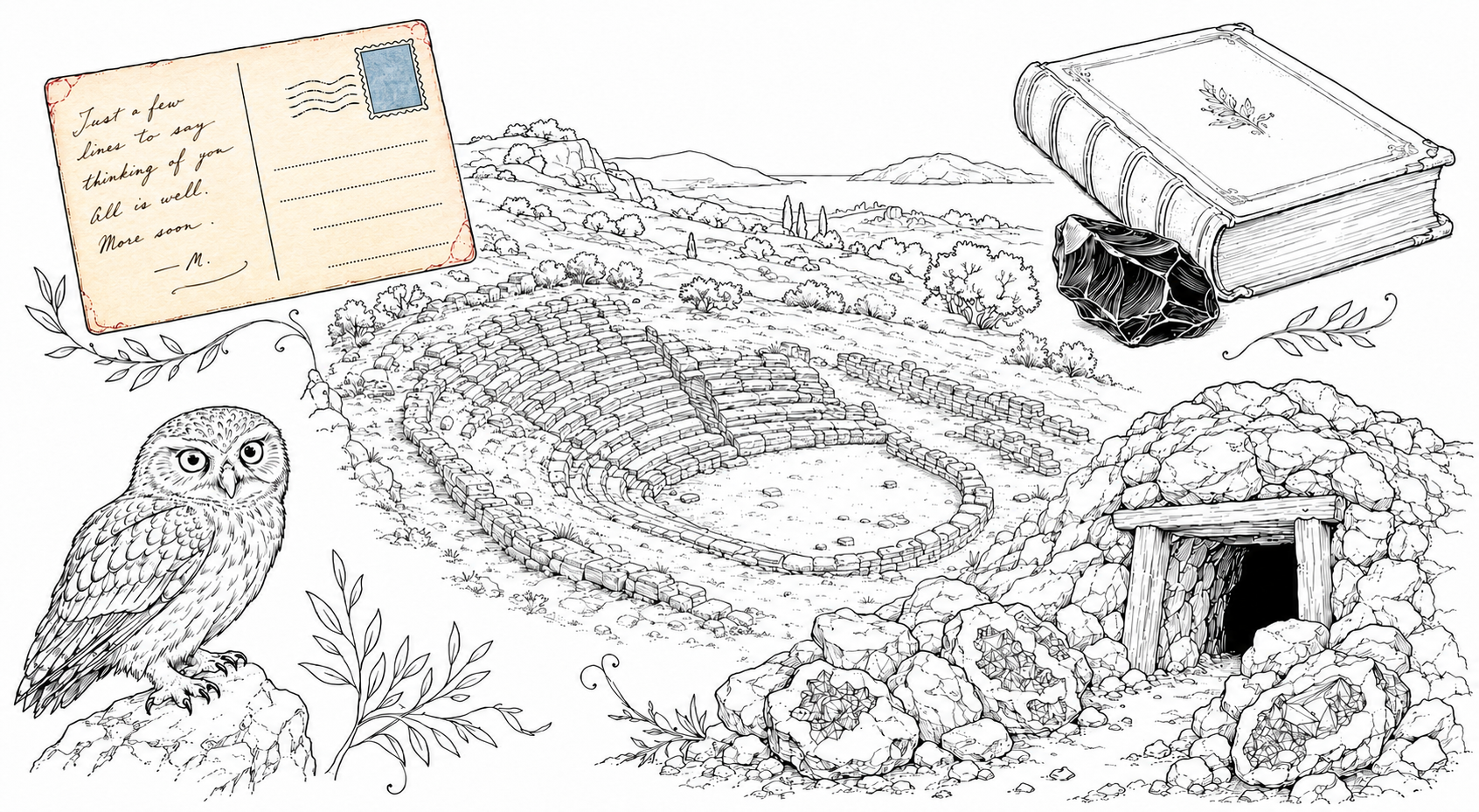
He opened the book at the page he had marked. The postcard was still there between the pages, its corner just visible enough to catch his eye.
On the front was a strange, asymmetrical ancient theatre, built into the earth as though it had shaped itself around something that had existed long before it and was not to be disturbed. The stone seating curved in a way that seemed more geological than architectural, as if the hill itself had decided to gather people in its embrace. There were no columns, no decorative flourishes, only the raw suggestion of a place where voices once carried upward into open air. On the back, there was only one sentence:
“If you ever find this, come before you decide that what frightened you was never meant for you.”
He read it again, although by now he knew it by heart. The handwriting slanted slightly to the left, as if the writer had been in a hurry, or as if the hand that formed the letters had not been entirely certain of what it was committing to paper..
His hesitation did not disappear, but merely became small enough to travel with him. He understood, without being able to name it precisely, that this was often the best one could hope for, not the vanquishing of doubt, but its quiet accommodation, a truce struck at the border of action..
When boarding was announced, he slipped the postcard back between the pages, returned the book to his backpack, and rose from his seat. The announcement came first in English, then in Mandarin, the two languages overlapping slightly in a way that made the instructions sound like a poem about departure..
On the plane, he came across people he knew. They greeted him with the spontaneous surprise reserved for finding someone in a place where you would never expect to see them, that particular brightness that contains, beneath its surface, the small discomfort of having been caught outside the boundaries of one’s ordinary life..
“Nikos? You? Are you going to Greece?”
He smiled and confirmed that yes, he was going to Greece. The questions followed quickly, the way they always did when people encountered the unexpected and tried to fold it back into the familiar. How long was he staying? Why was he going? Did he have relatives waiting for him? Was there someone there?
Nikos gave them only the answers they needed. He said enough to satisfy the shape of their curiosity without offering anything that would allow them to map the real territory of his reasons. They knew that he came from a Greek family. But he did not tell them what remained of those ties, whether anyone would be waiting when he arrived, or whether he was travelling towards a place where he knew no one at all. He did not mention the postcard, or the book, or the feeling that had been tightening beneath his ribs since he had left the house that morning..
Perhaps he did not want to explain it. Perhaps he did not yet know the answer himself. Both possibilities could be true at once. He had learned that much, at least, that not knowing could be a form of honesty, and that silence was not always the same as concealment.
It would be a long journey. All he wanted was to be left alone with his thoughts. He settled into his seat, allowed the engine noise to become a kind of enclosure, and opened the book again.
Before long, he was immersed in the story of Cephalus and Procris, a love that was not lost because it had never existed, but because suspicion, cruel tests, and half-truths had grown more powerful than the love itself. He read of a husband who could not believe he was loved without proof, and a wife who returned that doubt in kind, until the very instruments of their testing became the things that destroyed them. The story moved with the terrible logic of all myths: not because the characters were foolish, but because they were recognizably human, acting out patterns older than their own names..
The postcard remained hidden between the pages.
It was the only thing he had brought with him without knowing whether it belonged to him. Everything else, such as the clothes, the book, the carefully considered decisions that had led him to this seat, he could account for. But the postcard had arrived uninvited, discovered in a volume he had picked up almost by accident, carrying words addressed to no one in particular and yet, somehow, to him. He did not know if it was a message, a mistake, or something else entirely. He knew only that it had made itself necessary, and that sometimes necessity is the only form of belonging we are given..
to be continued..
In the next chapter:
While Nikos travels to Greece following the message on a postcard, a woman enters a bookshop somewhere in the South East part of the capital of Greece, without looking for anything in particular. Yet between the pages of an old book, something is waiting for her as well.. something that reflects not only her face, but what she is not yet ready to see..



Leave a Reply