
“Are you looking for anything in particular?”
Dina looked up from a stack of books that had just arrived. Open boxes surrounded her, filled with new releases that had not yet found their places on the shelves. The morning light entered the shop at an angle that made the dust visible, small particles drifting slowly through the air as though time itself had thickened in the presence of so many unread pages..
“No,” the woman replied. “I’m just looking.”
Dina smiled. She knew that “I’m just looking” was one of those things people said shortly before discovering something they had not known they were searching for. In her years of keeping this shop, she had learned to recognize the particular quality of attention that preceded such discoveries, a looseness in the shoulders, a gaze that moved without urgency, the body relaxing into a pace that had nothing to prove. The woman standing before her carried that looseness, but beneath it Dina sensed something else, a stillness that did not quite match the casualness of her reply.
“There are more upstairs,” she told her. “Go and have a look. I think you’ll like some of them.”
The woman walked towards the staircase. She had come to Lavrio without truly needing anything from the bookshop. She had wanted to see her friend Dina, spend a little time among the books, and perhaps buy something to keep her company over the coming days. Nothing more. The need for company had grown quietly, the way hunger does when one has been too occupied to notice its approach. She had not planned the visit. It just happened that morning as a small absence, a sense that the rooms of her own home had become too familiar, too willing to reflect back only what she already knew about herself..
Halfway up the stairs, she stopped beside the small window..
Books of different sizes and ages had been piled along its wide sill. Readers left them there for anyone who wanted them to take home and read for free, a quiet commerce of trust that required no transaction beyond the willingness to carry a story forward. Some appeared almost untouched, their spines uncreased, their pages still holding the stiff pride of the unopened. Others had worn spines, folded corners, and notes written by people she would never meet, underlining in pencils of various colors, small exclamation marks in margins, words circled as though the reader had needed to hold on to something and the page was the only thing available. She sometimes wondered about those readers, whether they had found what they were looking for in the words they marked, or whether the marking itself had been the only form of possession available to them..
Her eyes settled on an old book with a dark grey cover. The color reminded her of certain winter mornings by the sea, when the horizon dissolved into the water and the distinction between sky and land became a suggestion rather than a fact..
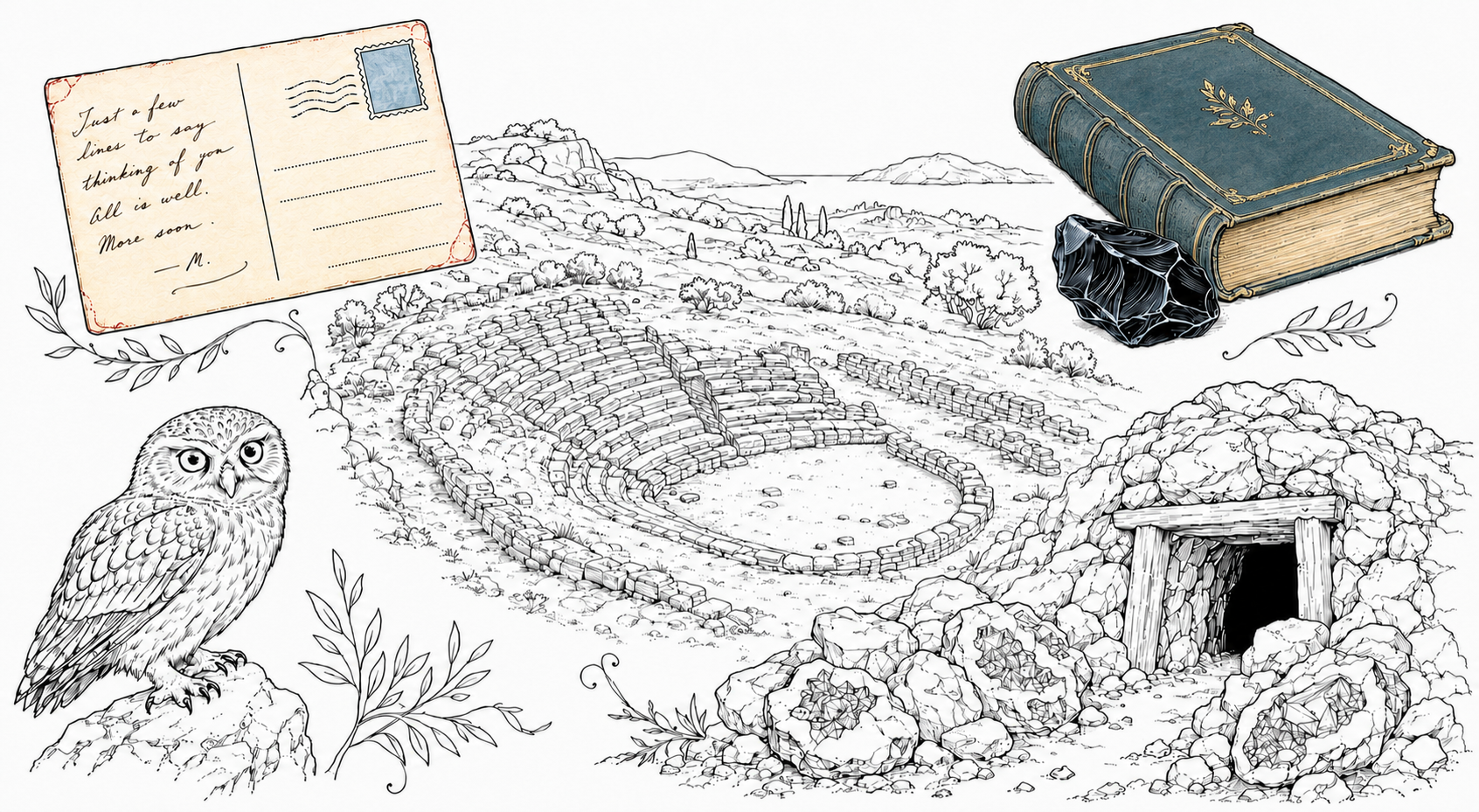
“What the Earth of Lavrio Concealed.” was the title that caught her eye..
She carefully pulled it from the pile. The cover had softened with age, the cloth yielding slightly beneath her fingers in a way that felt almost organic, as though the book had begun the slow process of returning to the earth it described. As soon as she opened it, something small and black slipped from between the pages and fell onto the wooden step with a sound that was softer than a click, sharper than a sigh..
She bent down and picked it up..
It was a thin, polished fragment of stone, smooth on one side and sharp along the edges. The contrast between its surfaces seemed deliberate, as though someone had worked to preserve both the comfort and the danger it contained. She lifted it towards the light entering through the window. For an instant, its surface became a mirror..
She saw her face.. Except.. she was not smiling..
The expression she saw was older than the one she wore, or perhaps younger .. it was difficult to tell. There was a gravity to it, a seriousness that spoke of something being witnessed rather than merely observed. It lasted only a moment, that other face, but in the way of moments that disturb our ordinary sense of ourselves, it elongated, stretching into a duration that felt closer to memory than to sight..
She lowered her hand at once and touched her lips, as though she needed to confirm the expression she was wearing. She was still smiling, or at least she believed she was. The muscles of her face held the shape of pleasantness, the social arrangement of features that she had learned to maintain without conscious effort. Yet the touch of her own fingers felt unfamiliar, as though she were encountering her face for the first time, or as though it had changed in some way that was too subtle for the mirror in her bathroom to record..
She looked at the stone again. This time, she saw nothing more than a dark surface in which a little light had become trapped, held in a depth that did not ask to be interpreted.
“Did you find something dear?” Dina called from below, her voice carrying the particular gentleness of someone who had learned not to startle people out of their private moments, but who still needed to maintain the continuity of the ordinary world.
“An old book.”
“Take it. Those are free.”
The woman placed the stone on the windowsill and turned a few pages. The book spoke of mine shafts, of silver hidden deep within the earth, and of the people who descended into darkness to bring it to the surface. The prose was plain, almost bureaucratic in its descriptions of ore yields and extraction methods, but beneath the factual language ran a current of something more difficult to name, an acknowledgment that the earth here had been wounded repeatedly, and that the wounds had produced a strange kind of wealth. Among its yellowed pages were photographs of abandoned entrances, ancient ore-washing installations, and places she had seen many times without ever stopping to truly look at them. They had been background to her drives, scenery for conversations, landmarks by which to measure distance. She had never thought of them as alive, as holding histories that continued to happen beneath their apparent stillness..
One sentence had been underlined in pencil: “Whatever comes into the light was not born there. For a long time, it existed in darkness.”
The underlining was careful, precise, as though the reader had wanted to emphasize not just the meaning but the rhythm of the words. She read them again, letting the sentence settle. There was something in it that resisted immediate understanding, something that asked to be carried rather than solved. She recognized the feeling from certain dreams that lingered into waking, dreams that did not need interpretation so much as they needed patience, a willingness to remain in their company until they revealed their own logic..
On the opposite page was an old black-and-white photograph of the ancient theatre of Thorikos.
She ran her finger over the stone rows of seats, the gesture more intimate than she had intended, as though her body had decided to know the place before her mind could give permission. She had never been there, although she lived so close. For a moment, she felt guilty. It was strange how easily we postponed discovering the places we believed would always be there, how readily we assumed that proximity guaranteed future attention. She thought of all the things she had told herself she would do eventually, the small pilgrimages she had deferred because there would always be time, because the place would not move, because it could wait. She understood now, looking at the photograph, that this was a kind of carelessness disguised as patience.
She would visit it soon, she decided. The decision arrived with unusual clarity, not as a resolution but as a recognition, as though some part of her had already begun the journey and was merely waiting for the rest to follow.
She looked at the photograph again. The theatre did not appear empty.. It appeared to be waiting..
The word came to her without her choosing it, and she did not try to replace it with something more rational. Some places held presence in a way that defied the distinction between occupied and unoccupied. She understood this without being able to explain it, in the same way that she understood certain silences between people, not as absences, but as forms of attention too concentrated for language.
She closed the book and tucked it beneath her arm. Then she picked up the black stone from the windowsill and slipped it into her pocket. The movement felt more significant than it should have, a small theft or a small rescue, she could not determine which..
“I did find something after all,” she called down to Dina.
She did not add that she had no idea what, exactly, she had found. The book and the stone sat together in her awareness as two parts of something that had not yet assembled itself, two fragments of a pattern she would have to live with before she could read it..
She continued up the stairs, never noticing that behind her, on the glass of the small window, her reflection had remained perfectly still..
And it was not smiling..
To be continued..
In the next chapter: In Athens, Nikos discovers that the owl on his postcard is more than an emblem. It sees where others perceive only darkness, and may know the way towards what the earth of Lavrio once brought into the light..



Leave a Reply