
The summer heat wave was unbearable.. From early morning, the sun had spread itself across eastern Attica without the slightest mercy. It arrived not as a gradual warming but as an occupation, claiming every surface, every shadow, every pocket of coolness that had survived the night. The asphalt trembled beneath the heat, releasing a soft, almost subterranean shimmer that made the distance appear to breathe, and every car seemed to be travelling in the same direction: towards the sea. The movement had the quality of a migration, thousands of individuals responding to the same ancient impulse without needing to name it.
It was one of those days when even people who loved summer searched for shelter from it. The mere thought of blue water was enough to make every other obligation seem less urgent, as though the heat had imposed a temporary philosophy in which survival and pleasure became indistinguishable. Appointments were postponed, responsibilities softened at the edges, and the city emptied towards the coast with a collective sigh that contained more gratitude than complaint.
The woman decided to go swimming.
For one of the very few times, she did not take the road towards her usual beach. She remembered a small cove near Lavrio where she had gone with a friend the previous summer. She could no longer recall the route clearly. All she remembered was the sea, the strange colors of the rocks, and the marks mining had left upon the surrounding land, scars that had become, with time, almost beautiful in their honesty. She had not planned to return there. The memory had simply surfaced that morning, arriving uninvited as certain memories do, carrying with it a sense of unfinished business that she could not yet articulate.
Her friend had said that she might join her there later. The conditional nature of the promise, might, not will, had lingered in the back of her mind without causing concern. She was accustomed to plans that dissolved, to the fluidity of summer intentions that shifted according to the temperature of the morning..
The woman took two wrong turns, followed a road that appeared to lead nowhere, and had to turn back when she found herself facing a locked gate. The discouragement was mild, almost pleasant in its way, a reminder that not all journeys could be controlled, that some destinations required the willingness to be lost first. Eventually, she recognized a bend in the road, more through instinct than memory, and the landscape opened before her to reveal the sea. The arrival felt earned rather than achieved, a gift offered at the end of a small test.
The beach was a hidden treasure nestled between the rocks. The water was clear and blue, while the stone around the shore shifted in color — grey, brown, red, and black, as though the earth had preserved traces of everything that had once been taken from within it. The variety felt deliberate, a kind of geological memory that refused to be reduced to a single narrative. She understood, standing at the edge of this fragment of coast, that she was looking at the surface of something much older than her comprehension, something that had witnessed extraction and abandonment and had continued existing without requiring human attention..
There were people there, though not as many as on the better-known beaches. Families had opened their umbrellas near the water, two children were attempting to build a tower from wet pebbles with the solemn concentration of architects engaged in sacred work, and an elderly man stood waist-deep in the sea, staring towards the horizon as though waiting for something to appear.. His stillness was so complete that he seemed less like a person swimming than like a figure from a painting, placed there to give the scene its necessary depth..
She spread out her towel, slipped off her sandals, and went straight into the water. The first contact was always a small shock, a negotiation between body and sea that repeated itself with each visit. Then the coolness enveloped her, and for a little while, the heat ceased to exist. It did not diminish, it was simply suspended, held at a distance by the greater authority of the water. She floated on her back, looking up at a sky so bright it seemed to have no color, only intensity, and felt the particular emptiness that comes when the body is relieved of temperature.
When she returned to her towel, she sat beneath her umbrella and watched the people around her. Being alone did not bother her. Solitude had always been a companion she could rely on, a presence that asked nothing and offered, in exchange, a certain clarity. But she had arrived expecting company and had given no thought to how she might spend the rest of her time. The oversight struck her now, not as carelessness but as a small failure of imagination, a reluctance to consider the possibility that the afternoon might need to be accounted for solely by herself..
Her phone rang.. It was her friend.
“I’m not going to make it after all,” she said. The voice carried that particular lightness people adopt when delivering disappointment, as though the failure to appear were a minor weather event rather than a choice. “I’ve got caught up here, and I won’t be able to come.”
“Don’t worry,” the woman replied. “We’ll see each other another time.” The words came easily, without bitterness. She had learned long ago not to measure friendship by susceptibility to disappointment.
She ended the call and looked towards the sea.
What was she going to do now?
Then she remembered the book.
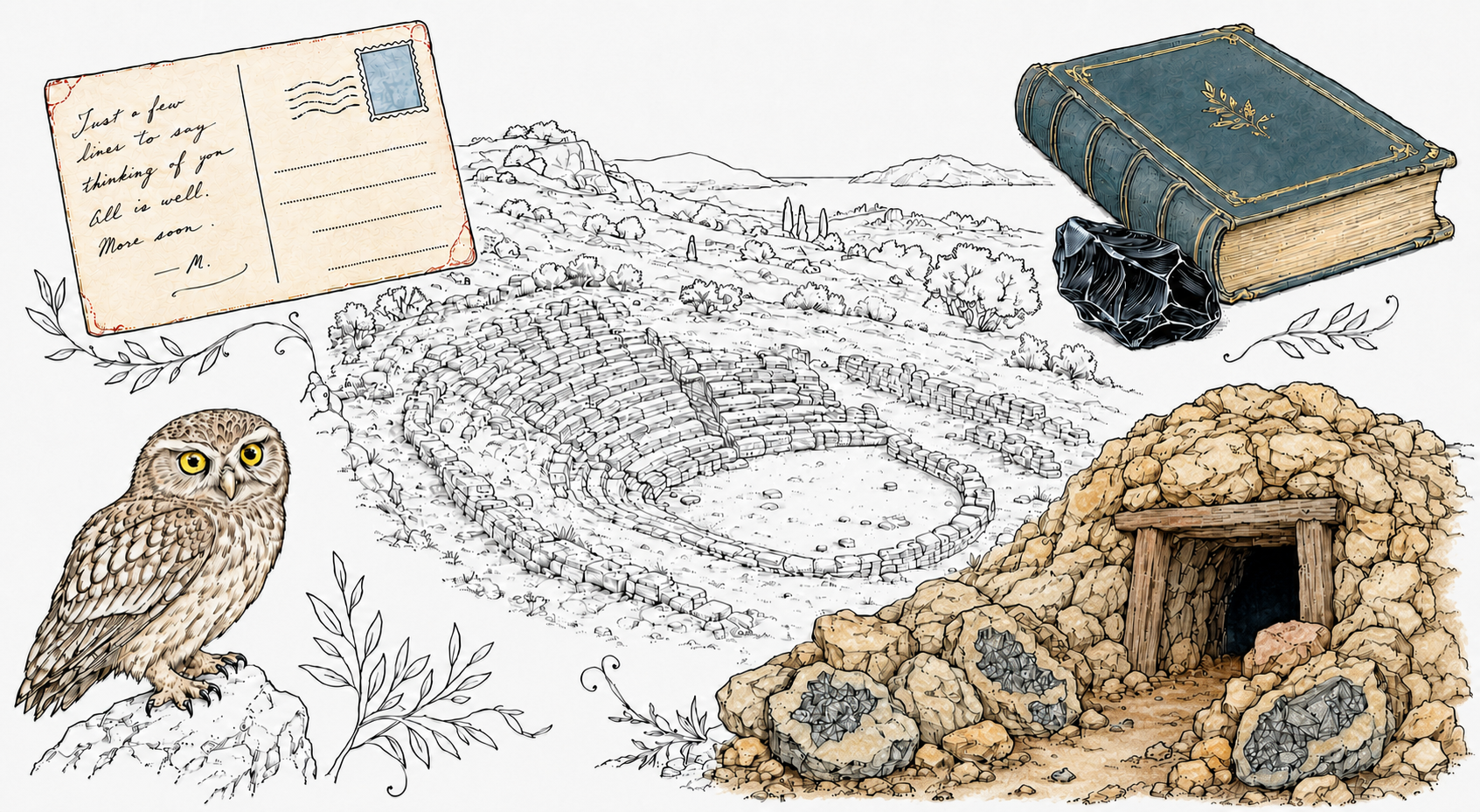
She had left it in her bag the previous day, carrying it more from habit than intention. She took it out and rested its dark grey cover upon her knees. The weight of it felt grounding, a small anchor in a place designed for drift..
What the Earth of Lavrio Concealed.
As soon as she opened it, the black stone slipped from between the pages and fell onto her towel. It landed without sound, a small dark punctuation against the brightness of the fabric.
She picked it up. It was warm, although it had remained enclosed inside the book, shielded from the sun. The warmth felt wrong, somehow, as though the stone were generating its own heat, remembering a temperature it had acquired elsewhere and refusing to surrender it. She raised it towards the sun, expecting the light to reflect from its polished surface, expecting some small flash of brilliance to confirm its ordinary nature.
But the stone reflected nothing..
Even beneath the blinding light of midday, it remained dark. The light seemed to enter it without returning, absorbed in a way that defied the behavior of ordinary stone. For a moment, it did not resemble a stone at all, but the entrance to a deep mine shaft, so narrow that only a person bent almost double could have passed through it, so dark that the eye could not find its bottom. She saw, or thought she saw, the rough edges of tunnel walls, the timber supports holding back the weight of earth, the terrible intimacy of a space designed not for human comfort but for extraction.
She lowered it quickly.
The image disappeared. Once again, it was only a small piece of black stone. She touched it with her fingers, running them across the smooth surface and then the sharp edges, seeking confirmation that what she had seen belonged to her eyes rather than to the object itself. The distinction no longer felt certain.
She placed it beside her and began to read.
The pages spoke of the silver of Lavrio, of the wealth and power it had brought to ancient Athens, of the coins, ships, and monumental works financed by everything the earth had concealed within itself. The language was measured, almost proud, recounting the achievements that had risen from this buried treasure. She read of markets and navies, of temples and democracies, all of them made possible by what had been drawn up from below.
But as she continued, the story grew darker.
The silver had not reached the surface on its own. Thousands of people had been driven deep into the narrow tunnels. They worked bent beneath the weight of dust, heat, and darkness to bring something precious into the light — something that would never belong to them. The book did not elaborate on their lives, did not offer names or individual stories, but the absence of these details felt more devastating than any description could have been. They were counted as numbers, as outputs, as the necessary cost of a brilliance that others would enjoy.
She paused at one sentence:
“The light that shone above the city had been paid for in darkness.”
She lifted her eyes towards the sea.
The sunlight glittered so fiercely upon the water that she had to close her eyes for a moment. The beauty was undeniable, almost violent in its intensity, and she thought of how easy it was to admire what appeared on the surface without ever wondering what had happened beneath it. The sea itself was like this, she realized.. Beautiful because it concealed its depths, admired because it did not reveal what it contained. We live, she thought, in a world of surfaces, and our admiration is drawn to whatever reflects the light most successfully.
The black stone still lay beside her.
This time, she did not raise it towards the light. She understood now that there were things not meant to be illuminated, materials that resisted the simple morality of reflection. The stone’s darkness was not a deficiency but a quality, a form of witness that did not require visibility to be real.
She read for a long while and then returned to the sea. The water received her with the same coolness as before, but she entered it with a different awareness now, conscious of the depths beneath her, of the pressures and temperatures that continued their existence whether she acknowledged them or not. By the time she came out, the heat had grown even heavier, settling onto her skin like a second clothing she could not remove.
She gathered her things and carefully slipped the stone back between the pages of the book. The gesture felt protective, as though she were returning something to a place where it could remain undisturbed.
She had planned to visit the ancient theatre of Thorikos before returning home. It was not far away, and she wanted finally to see the stone rows from the photograph with her own eyes, to confirm that they existed in three dimensions rather than only in the flattened space of a printed page. The intention had sustained her through the morning, providing a small architecture of purpose around which the day could arrange itself.
But when she reached her car, she stopped.
Two other cars had parked behind her in the narrow lane, completely blocking her way out. They had done so without malice, she could see, following the summer custom of squeezing into any available space without consideration for those who might need to leave. The carelessness felt less like offence than like a small lesson in the limitations of individual intention.
She looked around, but no one was nearby. She waited for several minutes and then several more, the time expanding in the way that waiting always expands it, each minute seeming to contain more than its share of stillness. The sun burned against the roof of the car, and the air had almost stopped moving. She could feel the heat beginning to work upon her patience, softening its edges, making the planned visit seem less like a possibility and more like a demand she was no longer certain she wanted to meet.
After quite some time, the drivers finally appeared. They knew they had blocked her in and hurried to move their cars as soon as they saw her, their faces carrying the particular embarrassment of people caught in a minor wrong that they had not, until that moment, recognized as wrong. They apologized, but by the time the lane was clear, far more time had passed than she had expected. The afternoon had shifted, the light beginning its slow turn toward evening without having delivered what she had hoped from it.
She climbed into her car and turned on the air conditioning. The artificial coolness struck her face with a shock that felt almost aggressive, a technological compensation for the natural world that arrived too late to truly restore her.
For a few moments, she remained still, her hands resting on the steering wheel. She could still go to Thorikos. The drive was not long, and the sun remained high enough to illuminate what she wanted to see. The possibility persisted, practical and available, waiting only for her decision.
But the sun remained high, the heat was oppressive, and the exhaustion of waiting had stripped the visit of all its anticipation. She understood, sitting in the enclosed coolness of the car, that arrival and fulfilment were not the same thing, that to visit a place without the capacity to receive it was a form of disrespect not to the place but to herself.
She did not want to arrive there irritated and tired.
“Tomorrow, when the sun is a little lower,” she said aloud. The words sounded like a promise, or perhaps like a ritual, a way of giving permission to her own reluctance.
She started the engine and took the road home. The return felt different from the coming, each familiar landmark now seen from the opposite direction, as though the landscape itself had been reversed by the failure of her plan.
Inside her bag, the black stone pressed against the photograph of the theatre.
For a moment, the stone rows of seats darkened..
As though they had filled with people..
To be continued..
In the next chapter : They thought they had merely postponed a visit. They did not yet know that the theatre had already arranged an encounter..


Leave a Reply