
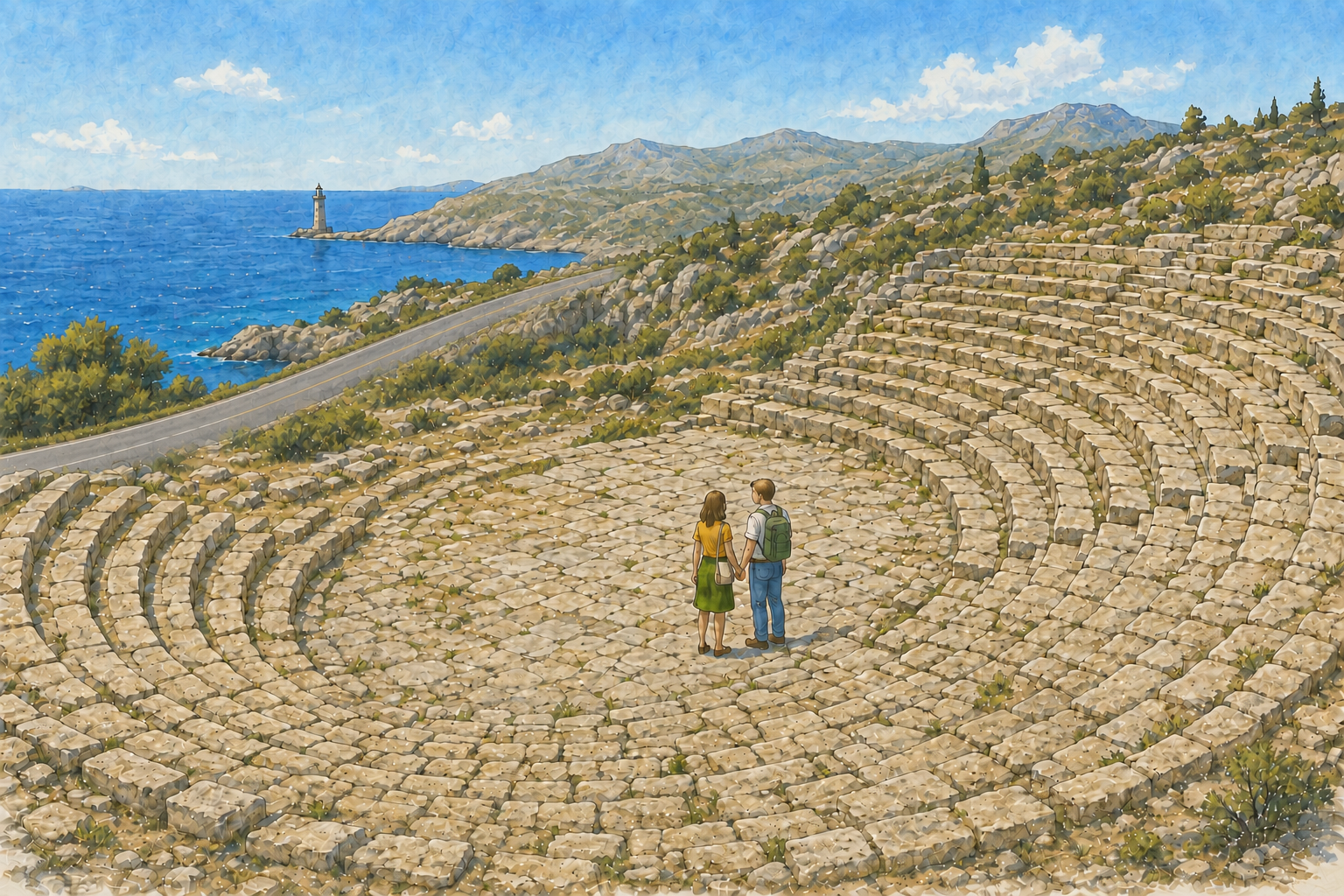
When they emerged from the tunnel, the sun had not yet set.
Nikos looked behind him. He expected to see the dark mouth of the ancient mine, the fork where he had abandoned the pickaxe, the formless figures still labouring beneath the earth. He expected, at the very least, some wound in the hillside, some visible interruption in the ordinary surface of things. But behind them there was only the hillside, bare and motionless, as though it had never opened at all. The dry grasses moved lightly in the wind, the stones held their late-afternoon warmth, and nothing in the landscape suggested that it contained passageways for memory, or judgement, or return.
The woman stood beside him, holding the book about Lavrion tightly against her chest. The gesture was instinctive, almost protective, as though the book were no longer merely an object she had picked up by chance, but something that had borne witness and therefore could not be held casually. The basket was gone. So was the black stone..
She opened her hand..
The obsidian was no longer there..
She searched her pockets and then examined the ground around her feet, although she already knew she would not find it. The movement was not really hope. It was habit, the body’s refusal to accept disappearance without first checking the obvious places. It had remained inside the tunnel with everything it had forced them to face. Perhaps that was the nature of such things: they appeared when language failed, did their work, and did not belong to the ordinary world long enough to be carried home.
Nikos was still holding his book about Cephalus and Procris. The postcard protruded from between its pages.
Those were the only things that had returned with them..
The two books and the card..
No tools. No proof..
The ancient theatre stretched before them once more. The stone seats were empty. The spectators had vanished, leaving neither voices nor shadows behind. The lighthouse had returned to its true height and could no longer be seen beyond the hills. Only a faint white line occasionally crossed the sky, so weak that it might have been the last light of day.
Or the memory of a beam.
For a while, neither of them spoke.
Nikos looked at his watch. Almost an hour had passed since the taxi had driven away.
Only an hour?! .. That was impossible!
Beneath the earth, it had seemed as though entire nights had passed. Time there had not moved according to clocks or shadows. It had stretched and contracted around what needed to be seen, giving confession the duration it required and the illusion of vastness because interior time is always larger than the measured world. And yet the sun stood only
And yet the sun stood only slightly lower than before, while the summer wind continued to move through the dry grass as though nothing had happened. The world had not paused for them. It had simply allowed them, for a time, to fall out of its ordinary rhythm and then returned them without explanation.
He took the postcard out of the book..
The woman looked at it, and something in her expression changed. It was slight, almost imperceptible, but enough for Nikos to notice. Her gaze sharpened, not with recognition exactly, but with the unease that comes when something long familiar begins to resemble itself too closely.
“What is it?” he asked.
She did not answer at once. She took the card carefully, holding it only by its edges, as though the pressure of her fingers might disturb something fragile and unfinished. On the back, the message that had brought Nikos there was still written:
If you ever find it, come before you decide that what frightened you was never meant for you.
Beneath the words were three small stains of ink. They almost touched one another, as though they had fallen from the same old fountain pen.
The woman ran her finger over them..
She did not remember seeing them when the postcard had landed at her feet. Or perhaps she had simply failed to notice them. Caught on one corner was a very fine red thread..
Her stomach tightened..
“It cannot be this one,” she whispered.
“Which one?”
She turned the card over again. Thorikos was still printed on the front, its asymmetrical theatre waiting beneath a faded sky..
But she was no longer looking at the theatre.. She was looking at a journal..
She had kept notebooks since childhood. Inside them, she pasted old tickets, dried leaves, photographs, letters she had never sent, and postcards from places she had visited or merely dreamed of visiting. Over the years, she had begun to give her journals faces, voices, and names. What began as habit had slowly become a private country, a place where memory could be rearranged until it was bearable, and where the things she could not say aloud learned to survive in altered forms.
One of her characters was Miss Pantologio, a girl made of paper, with a red ribbon in her hair and an enormous suitcase filled with memories. She travelled through stories gathering the things people lost or forgot: notes, clippings, tickets, little drawings, and postcards. She had been invented half playfully, half seriously, as many enduring figures are. At first Miss Pantologio had belonged to childhood. Later, she had remained because there were some truths the woman could only approach by giving them another voice.
Once, the woman had written that the lid of Miss Pantologio’s suitcase had suddenly sprung open..
The papers scattered everywhere..
And the elderly keeper of the library asked her: What did you drop?
The woman had never written the answer.
Until now.
“Do you know this postcard?” Nikos asked.
She looked at the red thread.
“No,” she said.
Nikos did not appear to believe her. For a moment, he looked at the postcard and then back at her. His distrust was not sharp as it might once have been. It came now with hesitation, as though he no longer trusted even his own reflex to doubt.
“Did you send it?”
“No.”
“Then how did it end up inside my book?”
The woman raised her eyes to his.
“I don’t know.”
It was the simplest answer she had given all afternoon.. And perhaps the truest..
A wind rose suddenly inside the theatre. It came neither from the sea nor down from the mountain. It circled the stone seats once, lifted the pages of both books, and made the postcard tremble between her fingers. The movement was narrow and self-contained, like breath taken in by the theatre itself.
Then came a deep wooden creak.. As though the sails of an ancient windmill had begun to turn somewhere far away.
The woman looked around her. There was no windmill at Thorikos. There were only the stones, the dry grass, and the sea growing dark beyond the hills.
The wind stopped as abruptly as it had begun..
The red thread had disappeared from the card..
“Pantologio,” the woman said, barely making a sound.
“What did you say?”
“Nothing. A name from a story.”
“Have you read it?”
She smiled uneasily. The smile held embarrassment, but not regret.. “I wrote it.”
In the distance, they heard the sound of a car. A taxi was slowly climbing the road towards the theatre. The ordinary noise of its engine seemed almost foreign after everything that had passed, as though the world of roads and appointments belonged to another scale of reality.
Nikos took the postcard when she handed it back to him, but he did not immediately return it to the book. He studied it as though expecting another sentence to appear upon it, or perhaps as though he were finally beginning to understand that some messages do not change because they already contain more than we are ready to read the first time.
“I never introduced myself,” he said. “My name is Nikos.”
“I know.”
His eyes lifted from the card.. “How do you know?”
She looked towards the hillside where, only moments before, the entrance to the tunnel had stood.
“I called you by your name in there.”
“That is precisely what I mean. How did you know it?”
She could have told him that perhaps she had heard it from the stones. From the invisible spectators. From the figures within the mine. She could have claimed that she had seen it written on the postcard or among the pages of one of the books. She could have offered any one of several explanations, each of them incomplete and all of them easier than admitting uncertainty.
But she did not want to begin again with a lie.
“I don’t know,” she repeated.
The lighthouse did not rise.. None of the stones began to glow.. The theatre remained silent..
Nikos waited for a moment, as though he expected her to give him her name. But the woman said nothing. Not because she wanted to hide, but because, for the first time, she did not feel compelled to explain her entire life in order to justify a single moment. Her silence no longer came from fear. It came from proportion.
The taxi stopped behind the blue car. The driver remained in his seat, allowing them a little more time. Whether he did so out of courtesy or because something in the atmosphere discouraged interruption, neither of them could tell.
“You have to return the book,” she said.
Nikos looked at Cephalus and Procris in his hands.
“Yes. A library always expects us to return what we have borrowed.”
“Not always exactly as we received it.”
He placed the postcard between the pages. This time, not as a bookmark, but as something he had to protect until he understood what it truly was. The gesture carried less urgency now, but more care.
He began walking down towards the taxi and then stopped.
When he turned around, there was no question concealed inside another. No test. No attempt to discover in advance whether her answer might hurt him. His face was open in a way that would once have frightened him.
“Will I see you again?”
The woman drew her book closer.
In the past, she would have told him that the world was small. That perhaps they might happen to meet again one day. That nothing could be planned. She would have used many reasonable words to conceal one simple desire. She would have softened the answer until it no longer revealed anything at all.
This time, she did not.
“I will find you.”
The sentence stood between them without ornament. It was neither romantic nor strategic. It was simply true.
They did not exchange telephone numbers.. They gave each other no addresses.. They promised nothing..
Nikos climbed into the taxi, and the woman remained beside her blue car. For a moment, they looked at each other through the window. Then the taxi pulled away, taking the road back towards Athens.
They did not leave hand in hand.. But they left having abandoned everything that had kept their hands bound..
When the woman opened her book about Lavrion, a small folded piece of paper slipped from between its pages. It landed softly against the stone near her feet.
She bent and opened it.
It was blank except for a faint drawing in one corner: a girl made of paper, with a red ribbon in her hair and a large suitcase behind her.. Miss Pantologio was smiling.. Beside her stood an old windmill, its sails turned towards the East..
The woman looked at the road along which Nikos had disappeared and then back at the drawing.. She did not know how the postcard had reached the other side of the world.. She did not know who had written the message.. She did not know whether her characters had truly escaped from their pages or whether, beneath the last light of Thorikos, she had begun to believe her own stories.. She knew only that, for years, she had used them to shelter everything she had not dared to live.. And now one of them had opened the door and stepped through it first..
From very far away, she heard the windmill once more..
A single turn..
Then silence..
Author’s Note
This story began when two people met online and discovered that, although they came from very different corners of the world, there was something strangely familiar in the way they wrote.. They shared interests, hobbies, perhaps even a few of the same small pleasures. Most importantly, they both loved fiction, the kind of stories that begin with a simple idea and then quietly decide they have plans of their own..
That is more or less what happened here..
There is no particular secret hidden behind these pages. There was inspiration, curiosity, and an attempt to place a few truths, especially truths seen from a woman’s side, inside a fictional story..
What I did not expect was how deep some of those truths would go..
I had not written a story for quite some time, and perhaps this is why Five Little Chapters became more important to me than I originally imagined.. Writing it led me down paths I had not intended to explore. Some belonged to the story. Some belonged to myself. And some appeared simply because, for this particular journey, I had a new fellow traveller walking beside me through its creation..
Perhaps that is one of the quiet gifts of writing with another person somewhere in the background: you discover not only how another mind sees a story, but occasionally how differently you can see yourself..
As for Nikos and the woman, I would rather leave a little space around them.. Fiction deserves some privacy..
I hope readers take something of their own from their encounter, perhaps the thought that not every meaningful meeting needs to arrive with a destination already decided. Some people enter our lives and change very little on the surface, yet somehow alter the direction in which we are looking. Some encounters become relationships, some become memories, and some become stories. Their value does not always depend on what happens next..
And perhaps there are truths we cannot say directly until we lend them to imaginary people, place them beneath an ancient theatre, hide them inside a book, or let them pass from one person to another on the back of a postcard.
If this story leaves you with anything, I hope it is a little curiosity about the unexpected people who cross our paths, and about the parts of ourselves we sometimes meet because of them..
And if it leaves you curious about Lavrion, then I will consider that another small victory.. Go there, if you can.. See the old mines and the sea. Feel the meltemi. Visit the ancient theatre of Thorikos and stand for a moment among stones that have watched people arrive, speak, love, lie, leave, and disappear for thousands of years..
Just don’t be too surprised if the place gives you a story of your own..
Tatiana,


Leave a Reply